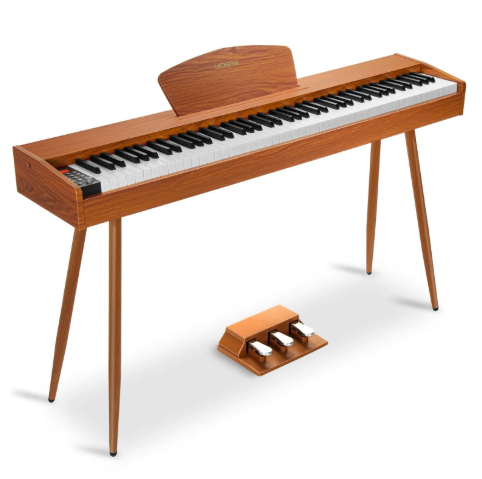
When shopping for a digital piano or keyboard, you will quickly encounter one of the most critical decisions in your musical journey: choosing between weighted and unweighted key actions. Beyond the number of keys, sound engines, or digital features, key action determines how the instrument responds under your fingers.
Choosing the right feel isn’t just about personal preference; it directly impacts finger strength, playing technique, portability, and how easily you can transition between different types of instruments. Understanding the nuances of key mechanics will help you select the action that best aligns with your musical aspirations.
Demystifying Key Action: What Do These Terms Mean?
The main distinction between key actions comes down to resistance and mechanical feedback. Acoustic pianos use a complex system of wooden hammers, felts, and levers to strike strings, creating natural physical resistance when a key is pressed. Digital instruments recreate or bypass this mechanical feel in different ways depending on their intended design and portability.
- Unweighted Keys: Common on entry-level synthesizers and ultra-portable keyboards, unweighted keys rely on light springs to return the key to its resting position. They offer almost no physical resistance, making them effortless to press.
- Semi-Weighted Keys: A middle-ground option that combines spring action with light weights attached to the keys. This setup provides slightly more resistance than unweighted keys while keeping the instrument lightweight and easy to transport.
- Fully Weighted Keys (Hammer Action): Designed to replicate the authentic touch of an acoustic piano. These keys use small mechanical hammers or weights to simulate the natural resistance, weight, and rebound of a traditional grand or upright piano.
For a comprehensive breakdown of mechanical differences across actions, exploring a guide on weighted vs unweighted keys can clarify which feel suits your specific playing habits and music styles.
Fully Weighted Keys: The Path to Authentic Technique
If your goal is to learn classical music, play on acoustic pianos, or develop proper finger independence, a fully weighted keybed is essential.
Pressing a weighted key requires building genuine hand strength and dexterity, particularly in your weaker fourth and fifth fingers. This resistance teaches you how to control key velocity—how fast or hard you press a key—which is how pianists produce rich dynamic range, from delicate pianissimos to powerful fortissimos.
When beginners practice exclusively on unweighted keys, they often struggle when transitioning to an acoustic piano because their fingers have not developed the necessary muscle memory to push through the heavier mechanical resistance. Investing in an 88-key weighted piano ensures that the finger strength and dynamic control you build during practice translate seamlessly to any traditional piano.
The Advantages of Unweighted and Semi-Weighted Keys
While weighted keys are the gold standard for traditional piano performance, unweighted and semi-weighted actions offer distinct benefits depending on what and where you plan to play.
- Portability: Fully weighted hammer mechanisms add considerable weight to an instrument. If you need an instrument for gigging, rehearsals, or small apartment spaces, unweighted models are significantly lighter and easier to carry.
- Fast Organ and Synth Techniques: Genres like organ, synth-pop, and electronic music rely on techniques like rapid palm smears, glissandos, and rapid-fire trills. Executing these moves on heavy weighted keys can be uncomfortable or even painful, whereas unweighted spring actions respond instantly to fast, light touches.
- Beginner Friendliness for Young Children: Very young beginners often lack the hand strength needed to press weighted keys comfortably without compromising their wrist posture. Semi-weighted keys offer enough feedback to learn basic notes without causing premature hand fatigue.
Matching Key Action to Your Personal Music Goals
To narrow down your choice, evaluate what you hope to achieve with your playing over the next few years.
If your primary goal is classical training, sit-down solo recitals, or passing formal piano examinations, choose a full 88-key weighted instrument from day one. Developing proper posture and technique early on prevents habits that can be difficult to correct later.
If you are producing electronic music, playing organ leads in a band, or simply looking for an affordable, space-saving instrument to learn pop melodies at home, an unweighted or semi-weighted keyboard provides maximum flexibility and convenience.
Final Thoughts
Neither key action is inherently superior; rather, each serves a distinct purpose depending on your goals. Fully weighted keys offer the authentic feel required for deep expressive control and traditional piano training, while unweighted keys excel in portability and fast synth playability. By matching your instrument’s touch to your musical goals, you set yourself up for a comfortable, rewarding, and inspiring learning experience every time you sit down to play.
