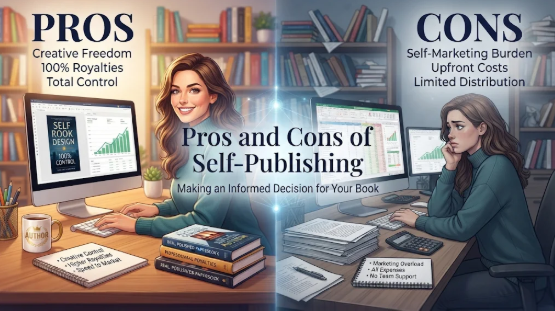
With the rise of self-publishing, the process of delivering books to readers has been revolutionized. Rather than solely depending on the traditional publishing company, writers have the ability to coordinate or delegate the essential tasks of editing, proofreading, formatting, cover art creation, distribution, and marketing of their books. While this may offer numerous benefits, it also requires writers to take charge of what would usually be the responsibility of the traditional publisher.
What Are the Main Benefits of Self-Publishing?
The first advantage of self-publishing is the control. The author has more control over the content, design, pricing, marketing strategies, and time of the book’s release. Self-publishing can be particularly beneficial for those authors who have a clear vision regarding their creative ideas and do not want to get permission from many people before making decisions.
Another important advantage is flexibility. In traditional publishing, there may be a long process of submitting and acquiring a manuscript, whereas in self-publishing, the author is free to prepare his/her book for release on his/her schedule. Also, digital self-publishing on Amazon Kindle Direct Publishing (KDP) is convenient.
How Does Self-Publishing Help Authors Reach Readers?
Self-publishing can provide access to international readers through online bookstores and digital distribution channels. Authors can make Kindle editions available to readers in different markets while also considering print-on-demand options for physical copies.
Authors can also experiment with pricing, promotions, book descriptions, advertising, and launch strategies. If one approach does not produce the expected results, it can often be adjusted. This ability to test and refine a publishing strategy gives writers more direct involvement in how their books are presented and promoted.
See also: Choosing an Industrial Cooling System That Delivers Long-Term Value
What Are the Main Disadvantages of Self-Publishing?
The main disadvantage is responsibility. A self-published author may need to coordinate editing, proofreading, formatting, cover design, ISBN requirements, distribution, and marketing. Although professional freelancers and publishing service providers can handle many of these tasks, the author still needs to choose suitable providers and oversee the overall project.
Costs can also become a concern. Although publishing an ebook can have a relatively low initial barrier, professional editing, proofreading, cover design, formatting, advertising, and other services can increase the total investment. Authors who handle everything themselves may save money but spend considerably more time managing the publishing process.
Quality control is another important consideration. Traditional publishers typically have established editorial and production teams, whereas self-published authors are responsible for ensuring that their books meet professional standards. A weak cover, inconsistent formatting, grammatical errors, or unclear book description can affect how readers perceive a title.
How Do Quality and Marketing Affect Self-Publishing?
Marketing can be challenging because publishing a book does not automatically generate sales. Authors may need to build an audience, establish an online presence, collect legitimate reviews, use social media, run advertising campaigns, or develop other promotional methods. This can be demanding for writers who would rather concentrate mainly on writing.
Authors who want professional support may consider British Publishing UK services to help with selected stages of the process. Depending on the provider, support may include editing, formatting, cover design, publishing guidance, distribution, or marketing. The exact services and costs should be checked before making a decision.
How Do the Advantages and Disadvantages Compare?
| Factor | Self-Publishing | Traditional Publishing |
| Control of the creative process | Usually more | Less |
| Time required for publication | Less flexible | Usually more |
| Responsibility to publish | Author’s responsibility | Publisher’s responsibility |
| Editing and design | Managed by author himself | Provided by the publisher |
| Promotion | Usually requires more work from the author | Sometimes help is provided |
| Price management | Usually more | Depends on negotiations |
| Sales network | Chosen by the author | Managed by the publisher |
In many cases, flexibility and control might be more important for an author than having a publisher responsible for the whole process of publication. On the other hand, many authors prefer professional assistance in publishing and do not want to deal with administrative issues. It all depends on the author’s experience and willingness to deal with book publishing issues.
What Should Authors Consider Before Choosing Self-Publishing?
Authors should first consider how much control they want and how much work they are prepared to manage. A writer who enjoys making decisions about design, pricing, promotion, and distribution may find the process rewarding. Someone who wants to focus primarily on writing may prefer to outsource several stages or explore other publishing routes.
The budget should also be considered carefully. Instead of looking only at the cost of getting a manuscript online, authors should consider the complete publishing process. Editing, proofreading, professional formatting, cover design, marketing, and revisions can all affect the final budget.
Another factor authors must consider is their target audience and format preferences. While an ebook format is suitable for people who enjoy digital books, a paperback or hard cover might work better for those interested in having physical books. However, the author should still be aware of the platform specifications, royalties, metadata, and other details.
Writers researching self publishing UK options should compare the services offered by different providers before committing. Checking what is included in a package, who owns the rights, how revisions are handled, what distribution channels are available, and whether marketing support is included can help prevent unexpected costs or limitations.
How Can Authors Make Self-Publishing More Manageable?
One practical way is to make a publishing checklist ahead of time. The checklist may contain such elements as manuscript editing, proofreading, formatting, cover design, ISBN needs, setting up on Amazon KDP, pricing, distribution, launch, and promotion after publishing.
The author will be able to choose the things that he/she can do personally and the things that he/she needs professional help for. Hiring specialists can increase the quality of the publication process and let the writer focus on writing and building an audience.
Professional help can be especially useful for debutants who are not aware of the publishing demands. Yet the authors need to do research on service providers, study the contracts, understand ownership, and know exactly what they get paid for.
www.britishselfpublishing.co.uk
Is Self-Publishing Right for Every Author?
Self-publishing is definitely not for all writers. Self-publishing ensures control and freedom but at the same time puts the burden of responsibilities on the author himself. The method will prove useful for those authors who are ready to take care of or outsource the required steps and spend some time making a book professionally.
Thus, the right choice should be made according to one’s own priorities. The author needs to weigh his budget, timeframe, desired level of control, knowledge about the publishing industry, target readership and willingness to deal with marketing.
