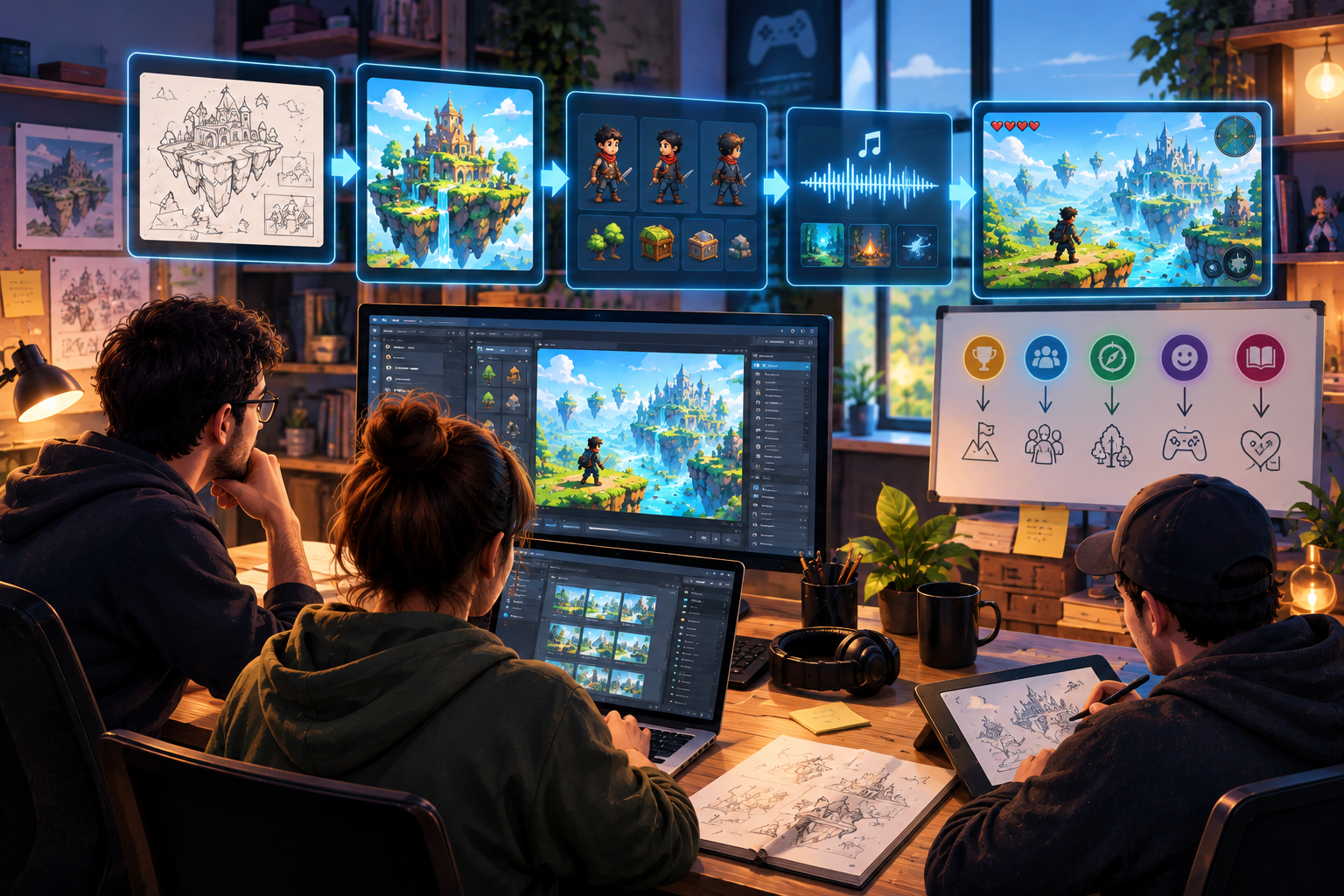
Small creative teams operate under constraints that larger studios don’t: limited budget, generalist roles where one person handles multiple responsibilities, time pressure that makes inefficiency genuinely costly. Those constraints aren’t character flaws or limitations to overcome, they’re actual conditions that shape what kind of game development works realistically. AI game makers have opened up a specific set of development approaches tailored to exactly these constraints, not because they’re “easier” alternatives, but because they’re actually well-suited to how small teams work best.
Why Small Teams Have Always Needed Different Approaches
Specialization Doesn’t Scale Below a Certain Size
A large studio can afford a dedicated programmer, artist, designer, and audio specialist per project. A three-person team can’t. Each person has to wear multiple hats, which means everyone spends time on things outside their core strength. That inefficiency is just the reality of small-team development, not something specialized tools can fully eliminate.
Iteration Speed Matters More When Resources Are Limited
When you have limited time and money, discovering a flawed concept early is critical. A large studio might build extensively around a mechanic before testing it thoroughly. A small team can’t afford that waste. Development approaches that validate concepts quickly matter far more to small teams than to anyone else.
See also: Understanding What the Apple Watch Actually Offers
Timeline Pressure Is Real and Constant
Small teams rarely have the luxury of long development cycles. Every project is under timeline pressure because the team can’t afford to support extended projects financially. Approaches that compress timelines without sacrificing quality directly impact whether a small team can ship anything at all.
How AI-Assisted Development Specifically Helps Small Teams
Covering Multiple Roles Becomes Realistic
One person can now describe a game concept, watch it become playable, and evaluate it critically without needing specialized coding, art, or audio skills. That role-compression is what makes small teams viable in the first place. AI tools don’t eliminate the need for good design thinking, they just remove the requirement for five different specialized skill sets.
Rapid Prototyping Reduces Risk
Small teams often bet their limited resources on a single direction. Fast prototyping lets them test multiple concepts and pick the strongest one before committing resources, reducing the risk that an unproven direction will consume an entire project’s timeline.
Asset Production Stops Being a Bottleneck
Without asset generation, small teams either had to commit one person primarily to art production or ship something visually rough. AI-assisted asset generation removes that forced choice by making basic-to-solid visual and audio assets available automatically.
Freelancer Coordination Becomes Optional
Larger productions often require coordinating with freelance artists, composers, and other specialists to fill skill gaps. Small teams using AI asset generation can reduce that coordination overhead significantly, keeping more of the project internal and simpler to manage.
Development Approaches That Work Well for Small Teams
Rapid Iteration on a Single Core Concept
Rather than building a large, feature-rich game slowly, small teams often do better focusing on one strong mechanic and iterating it deeply. AI tools support this approach perfectly by making each iteration cycle fast enough that refinement becomes the default rather than a luxury. Minecraft: Moon School shows how a focused, well-tuned concept executed with clear intent can deliver a complete, satisfying experience without needing expansive scope.
Parallel Prototyping of Multiple Directions
Rather than committing to one concept and hoping it works out, small teams can now prototype several ideas in parallel, test them against each other, and pursue the most promising direction. That comparison-driven development is more realistic for small teams than it’s ever been.
Outsource Decisions, Keep Design Internal
A small team can outsource asset generation, certain technical implementations, or other production tasks while keeping core design and creative direction entirely internal. That outsourcing model preserves what makes the team’s specific vision unique while reducing the bottlenecks that slow everything down.
Build for Specific Audiences Rather Than Broad Appeal
Large studios often need to appeal to broad audiences to justify large budgets. Small teams often succeed by serving specific, well-understood communities deeply rather than trying to appeal to everyone. AI development approaches support this specialized focus perfectly.
Specific Game Ideas Small Teams Can Execute Well
Mechanically Focused Games With Strong Community Features
Social games, competitive leaderboard-driven experiences, and games built around specific mechanics rather than sprawling content benefit enormously from what small teams do well: focused design, tight iteration, strong community connection. A small team can build a game around one mechanic better than a large team can, especially when multiplayer or social features make the mechanical core more engaging.
Niche, Audience-Specific Games
Games designed specifically for a particular audience, educators, a specific hobbyist community, streamers, specialized competitive players, allow small teams to compete with larger studios. Size doesn’t matter when you understand your audience better than anyone else does.
Rapid-Release, Seasonal Content Models
Rather than building one large game over months, small teams can build several smaller games or seasons of content more frequently. That faster release cycle suits AI development perfectly and creates reasons for communities to return repeatedly rather than waiting for rare large updates.
Collaborative Creative Games
Games focused on player creativity, building, customization, or shared creative expression often succeed with small teams because the creation tools and community management matter more than raw content volume. A small team with strong creative direction can outperform a large team with mediocre vision.
Educational or Purpose-Driven Games
Games with specific educational goals, teaching a skill or concept, or advancing a cause often succeed because the underlying purpose creates engagement that pure entertainment mechanics struggle to sustain. Small teams building games aligned with their actual values often produce work that resonates more than larger studios chasing trends.
Practical Workflow Adjustments for Small Teams
Validate Concepts Before Committing to Polish
Use fast prototyping to confirm that a core concept genuinely works before investing time in refinement. A small team that validates wrong will waste precious resources. One that validates thoroughly early can polish confident.
Rotate Roles Deliberately Rather Than Hoping for Coverage
Instead of assuming one person will somehow cover multiple specialties, rotate people through different roles intentionally. Someone who handles design also spends focused time on community management or playtesting, deliberately building redundancy in critical skills.
Use External Feedback as a Design Tool, Not a Validation Luxury
Small teams should get outside reactions to work constantly and early, not just when something feels finished. That feedback drives better decisions than internal-only iteration ever could, and saves wasted effort on directions that don’t resonate outside the team.
Embrace Constraints as Creative Fuel
Time limits, budget limits, team-size limits, these create constraints that often force creative solutions. Small teams that view constraints as creative challenges rather than failures produce more distinctive work than those fighting against inherent limitations.
Tools and Approaches Beyond Just Game Makers
Combine AI Game Makers With Community Platforms
Build a game through AI platforms, then use community management and social tools to build connection and retention alongside the game itself. Small teams’ strength is often in community building rather than raw content volume.
Use Existing Engines for Specialized Needs
AI game makers handle common patterns excellently. For the specific requirements that fall outside that scope, small teams can reach for traditional engines. That hybrid approach captures both the speed advantage and the flexibility when needed.
Collaborate With Other Small Teams Rather Than Competing
Small teams often succeed better when they collaborate on shared projects, share resources, or coordinate marketing rather than each trying to compete in isolation. AI development tools make this kind of collaboration easier by reducing coordination overhead.
Common Mistakes Small Teams Make With AI Tools
Confusing Speed With Quality
Fast generation doesn’t mean the result is automatically good. Small teams sometimes ship first versions without the playtesting and refinement that actually makes work worth releasing.
Losing Distinctive Vision in Pursuit of Speed
The advantage of a small team is often that cohesive, distinctive vision. Rushing through design iteration to just ship something fast can sacrifice the thing that made the team worth attention in the first place.
Underestimating the Need for Community Management
Technical execution is only half of what makes a game succeed with small teams. The other half is building and sustaining community. AI tools handle technical stuff but don’t replace genuine community work.
Expanding Scope Because Generation Feels Easy
Just because building feels fast doesn’t mean a small team can handle a large game. Keeping scope realistic to what the team can actually manage remains critical.
Final Thoughts
AI game development approaches work particularly well for small creative teams not because they remove the need for good design thinking or community building, but because they eliminate friction points that used to force small teams to choose between competing limitations. A three-person team can now validate concepts quickly, generate usable assets automatically, and focus their limited time on the decisions that actually matter: whether the core concept is engaging and whether the community feels connected.
The teams leveraging this advantage best aren’t the ones trying to build like large studios with smaller headcount. They’re the ones doing what small teams have always done best: focusing deeply on a specific vision, building tight community around it, and iterating based on real feedback rather than assumption. AI tools just make that approach more realistic by removing the overhead that used to make it impossible.
